
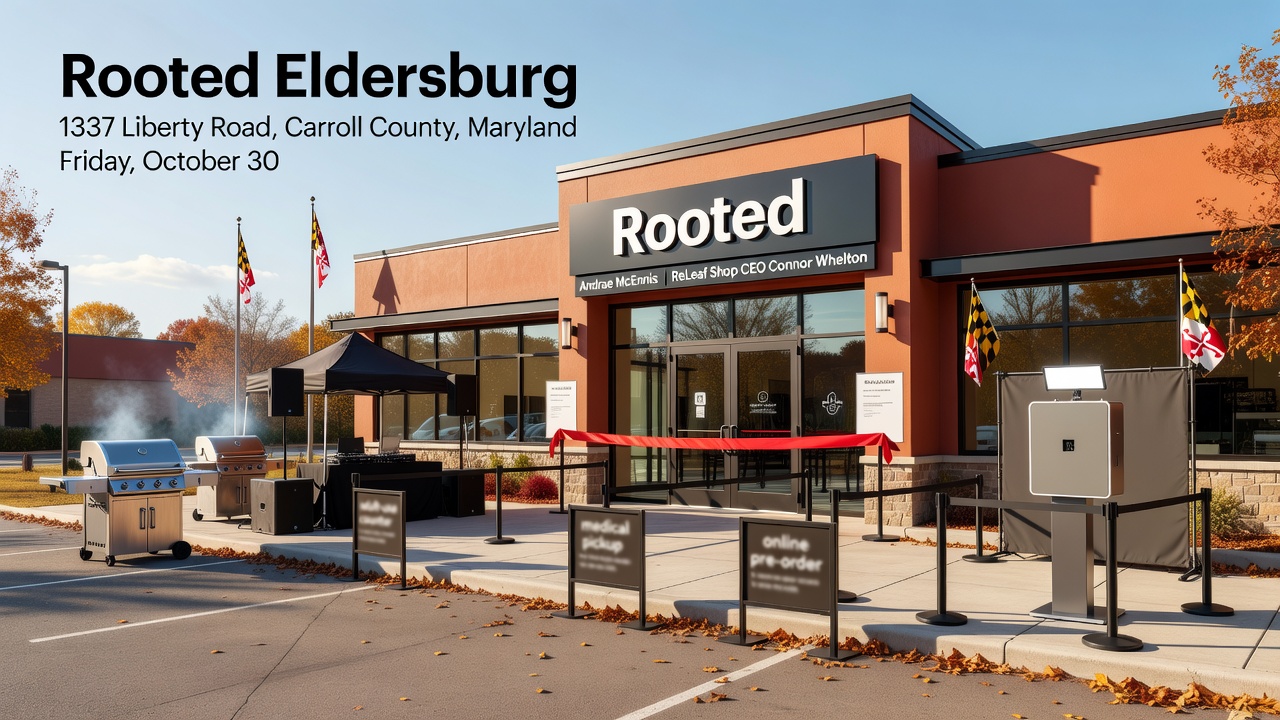
Rooted, the Eldersburg dispensary built through a partnership between Andrae McEnnis and ReLeaf Shop CEO Connor Whelton, will hold a grand-opening celebration on Friday, October 30, at 1337 Liberty Road. The store is already open and selling; the event is a ribbon-cutting and community gathering layered on top of an operating business, not a launch day. That distinction matters more than it might seem, because in regulated cannabis retail, a marketing event and a point-of-sale transaction run on two very different sets of rules.
A storefront party, a licensed transaction
Barbecue, a photo booth, a DJ - the programming reads like any small-business grand opening. Underneath it, though, Rooted operates as a licensed Maryland dispensary, which means every sale still runs through the state's age-verification and identification requirements regardless of what's happening in the parking lot. The Maryland Cannabis Administration requires customers to be at least 21 and to present valid government-issued photo ID at the point of sale. A festive atmosphere doesn't change that checkpoint, and it shouldn't be mistaken for one.
Here's the catch worth flagging for anyone planning a visit: an event schedule and a shopping visit are not the same transaction. A ribbon cutting at 1 p.m., an online order placed earlier in the day, and a medical pickup later in the afternoon are three distinct interactions with the same storefront. Confirming which service applies - adult-use counter, medical queue, online pre-order pickup - avoids the assumption that one printed schedule covers the entire retail operation.
Discounts, medical status, and the line between them
Rooted and ReLeaf have announced a standing 25 percent discount on non-sale products for active-duty and retired military customers, framed as a daily policy rather than a one-time promotional stunt tied to the opening. That's a meaningful retail decision - veteran discounts are common in cannabis retail as a customer-acquisition and loyalty tool - but it's worth separating from Maryland's medical cannabis program entirely.
A military discount is a pricing mechanism. Medical cannabis eligibility is a regulatory status, established through a separate registration process for Maryland residents whose providers recommend cannabis for a qualifying condition, with provisions for registered caregivers under program rules. The two systems don't intersect. A veteran getting a retail discount has not thereby qualified for, or been granted, medical patient status, and the MCA's guidance is clear that medical cannabis costs are not reimbursable through private insurance, Medicare, Medicaid, or veterans' covered plans. For operators, this is a recurring compliance and customer-communication issue: discount programs and medical registration need to stay in clearly separate lanes at the register and in signage, so budtenders aren't fielding confused questions about coverage that doesn't exist.
Tax treatment is not static, and that matters at checkout
Medical cannabis sales to registered patients and caregivers are exempt from Maryland sales and use tax. Adult-use purchases are not exempt, and the applicable rate has moved - the state's adult-use cannabis tax rose from 9 percent to 12 percent beginning in fiscal 2026, according to a Department of Legislative Services fiscal note. That's a real operational detail for any dispensary's point-of-sale configuration and for customers doing their own math on a menu price. A percentage-off headline, applied before tax and before confirming purchasing status, won't produce an accurate final total. For operators running SKU-level pricing across medical and adult-use categories, keeping tax logic current in the POS system isn't optional - it's the difference between a compliant receipt and a pricing error that erodes trust at the counter.
Purchase limits and public-consumption rules still apply
Maryland's adult-use framework sets purchase caps by product form - 1.5 ounces of flower, 12 grams of concentrate, or 750 milligrams of THC in specified products per transaction. These are legal ceilings on what can be purchased, not consumption guidance, and they apply on a grand-opening Friday the same as any other day. The state also prohibits smoking cannabis in public places and using it while driving. An event with food and music is not an invitation to consume on site, and transportation planning belongs in the pre-visit checklist, not an afterthought.
- Confirm which service line applies: adult-use, medical, or online pickup.
- Bring valid government-issued photo ID regardless of the day's programming.
- Verify discount eligibility rules and which products qualify before assuming storewide application.
- Check current tax rates against menu pricing rather than relying on older figures.
- Remember purchase limits and public-consumption restrictions remain in effect during any store event.
The opening gives Carroll County a chance to meet the operators behind an already-functioning dispensary. The more durable takeaway for the industry is procedural: events, discounts, and medical-program rules are three separate systems that happen to share a storefront, and treating them as interchangeable is where confusion - and compliance risk - tends to start.