
Hemp Industry Sues Missouri to Block Intoxicating Products Ban Before November Deadline
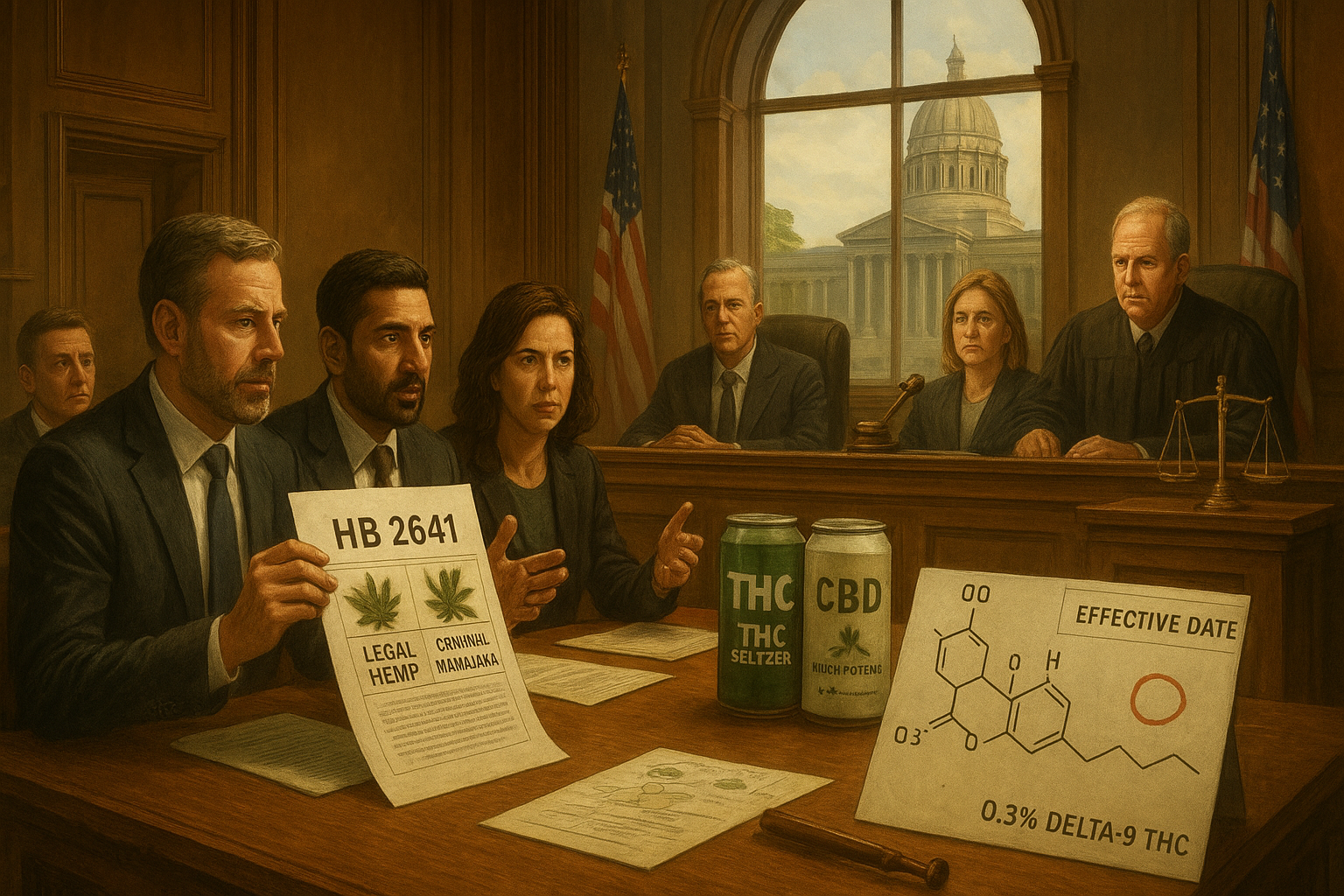
A coalition of hemp businesses filed a federal lawsuit Thursday seeking to stop Missouri's statewide ban on intoxicating hemp products from taking effect November 12. The suit, filed in U.S. District Court for the Western District of Missouri, targets a law signed earlier this year by Gov. Mike Kehoe that would remove THC seltzers, high-potency CBD products, and other intoxicating hemp items from grocery stores, bars, and smoke shops across the state. The plaintiffs argue the legislation is so poorly drafted that it creates unconstitutional legal exposure for businesses that have operated lawfully under federal hemp rules since 2018.
The coalition includes MNG 2005, Inc. - the St. Louis-based parent company of 55 CBD Kratom retail locations nationwide - the Missouri Hemp Trade Association, and Wisconsin-based Lifted Liquids Inc. For multi-location hemp retailers like MNG, the stakes extend well beyond Missouri's borders; a precedent-setting ruling here could shape compliance strategy in every state where intoxicating hemp products currently sit on shelves outside the licensed dispensary channel. Operators tracking similar regulatory shifts in other markets can read more about how state-level cannabis market structures are evolving. The lawsuit names Gov. Kehoe, Missouri Attorney General Catherine Hanaway, and Sarah Wilson, director of the Missouri Department of Health and Senior Services, as defendants.
The core legal argument centers on definitional incoherence. According to the coalition, HB2641 defines the same products as both "hemp" and "marijuana" in different provisions - a distinction that carries serious weight, because unlicensed marijuana activity is a criminal offense in Missouri. Craig Katz, government relations and compliance manager at MNG, put it plainly: "A lot of this stuff is kind of in the weeds. It's very difficult to understand. And when people are trying to legislate it, if they don't understand it, you come up with something like HB2641, which doesn't make a whole heck of a lot of sense." That's not a minor drafting error. When criminal liability turns on which definitional provision a prosecutor or law enforcement officer reaches for first, businesses face compliance risk they cannot reasonably manage.
What the Law Actually Does - and Why the Confusion Matters
Missouri's HB2641 broadly mirrors the federal framework Congress approved to restrict intoxicating hemp-derived products. Under the state law, all intoxicating hemp products come off shelves November 12. If Congress reverses the federal ban, Missouri would require those products to be sold only through licensed marijuana dispensaries. If Congress delays the federal ban, Missouri's law would still prohibit everything except intoxicating beverages. That structure hands the licensed marijuana dispensary channel a significant commercial advantage - something the Missouri Hemp Trade Association's president, Jay Patel, called bluntly: "This isn't consumer protection. It's the elimination of an entire legal industry coupled with a government-mandated monopoly."
The coalition also challenges the law's restrictions on interstate hemp transport and argues the effective-date provisions are too convoluted for businesses to determine which products are covered or when. That's an operational problem with real consequences. Retailers managing inventory across state lines - whether they're running delivery manifests or wholesale purchase orders - need clear, enforceable definitions to build compliant SKU lists. Ambiguous statute language doesn't just create legal risk; it makes routine compliance work impossible.
The Broader Regulatory Pressure on Hemp Retail
Missouri's law didn't emerge in a vacuum. Similar legislation failed in the state in 2023 and 2024, largely because the hemp industry's commercial footprint in smoke shops, convenience stores, and specialty CBD retailers was substantial enough to slow legislative momentum. Without regulations, products with as much as 1,000 mg of THC were reportedly sold in Missouri smoke shops - outside the licensed marijuana program entirely. That reality gave bill sponsor Rep. Dave Hinman, a Republican from O'Fallon, a defensible public rationale: the legislation, as he framed it, gives state law enforcement the tools to enforce the federal hemp ban once it takes effect.
Hinman was direct about his read on the lawsuit: "I believe this is the last ditch effort for the hemp industry. HB2641 passed the Missouri House, Senate and was signed by the governor. It was vetted throughout the entire process." Fair enough - the legislative process ran its course. But vetting a bill's political path is not the same as vetting its constitutional draftsmanship, and that's precisely what the plaintiffs are asking a federal court to examine.
What Operators and Compliance Teams Should Watch
For hemp retailers, CBD brands, and distributors with Missouri exposure, the November 12 effective date creates a hard planning deadline regardless of how the lawsuit proceeds. Courts do not move on retail timelines. Unless a preliminary injunction is granted before that date, businesses operating in the gray space between hemp and marijuana regulation need to assess their inventory exposure, consult compliance counsel, and make product decisions now - not after an adverse ruling.
Licensed marijuana dispensaries in Missouri, meanwhile, are watching this lawsuit from the other side of the counter. If the ban holds and the product categories eventually migrate into the dispensary channel, operators will need to evaluate whether intoxicating hemp beverages and similar SKUs fit their existing compliance infrastructure - including potency testing requirements, compliant packaging standards, and point-of-sale age verification protocols. That transition is not automatic, and it isn't without cost.
The hemp industry's constitutional argument may or may not prevail. What's already clear is that the definitional line between hemp and marijuana - drawn federally at 0.3% delta-9 THC on a dry-weight basis - was never designed to accommodate the product innovation that followed. State legislatures trying to close that gap without understanding the underlying chemistry have, in more than a few cases, produced statute language that creates more legal uncertainty than it resolves. Missouri may be the next test case for how far that ambiguity can stretch before federal courts push back.