
Dispensary Loyalty Programs Are Growing Fast but Failing to Activate Most New Members
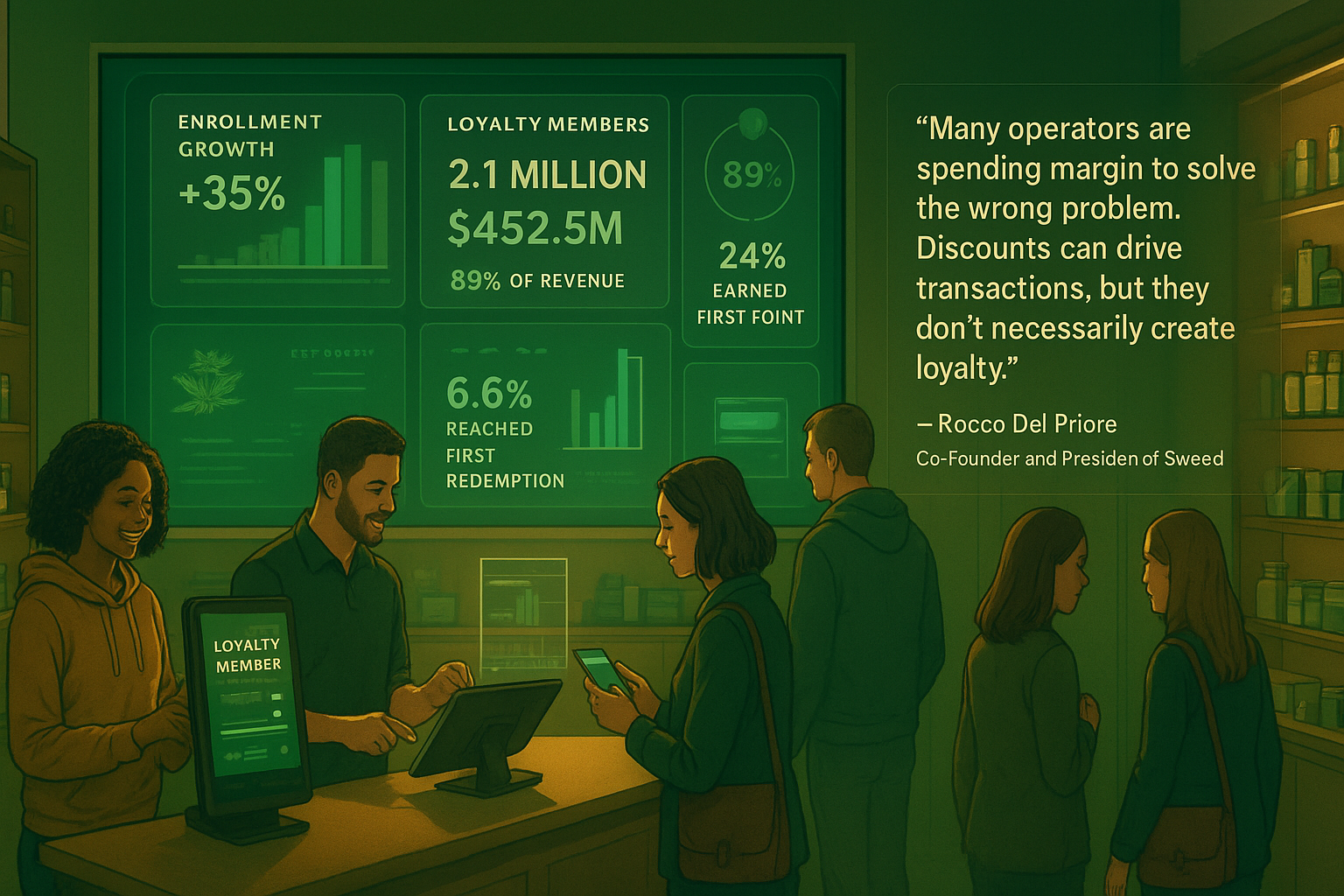
Enrollment in dispensary loyalty programs is climbing sharply, yet the majority of new members never earn a single reward - and that gap is quietly draining retention value from one of the industry's most relied-upon tools. New benchmark data from Sweed, drawn from 2.1 million cannabis shoppers and $452.5 million in retail revenue across active loyalty programs in Q1 2026, shows that loyalty members already account for 89% of dispensary revenue and represent 81.7% of active customers. The numbers confirm what many operators suspect but few have quantified: loyalty programs aren't a secondary feature of dispensary retail. They are the revenue engine.
Here's the catch, though. Despite year-over-year enrollment growth of approximately 35%, fewer than one in four new members earns their first loyalty point - and just 6.6% reach their first redemption. Operators are winning the sign-up but losing the relationship almost immediately after. For multi-location operators and single-store independents alike, that's a structural problem worth examining carefully; enrollment costs time, budget, and often a sign-up incentive, none of which generate return if the member never engages again. Dispensary operators looking to understand how regional market dynamics - including state-specific compliance requirements and consumer behavior - shape loyalty program design can learn more about how those variables play out across different regulatory environments.
What's striking here is that the data doesn't point to price sensitivity as the primary driver of churn. Members who do reach their first reward are getting there faster than before - meaning the program mechanics aren't necessarily broken. The problem is earlier: too many customers enroll and disengage before they ever experience value. "Many operators are spending margin to solve the wrong problem," said Rocco Del Priore, Co-Founder and President of Sweed. "Discounts can drive transactions, but they don't necessarily create loyalty. The biggest opportunity isn't getting more people to join a program - it's getting more members to engage with it."
Why Discounting Alone Doesn't Build Retention
The cannabis retail industry has leaned heavily on promotional discounts - daily deals, first-time buyer offers, flash sales - partly because advertising restrictions limit conventional customer acquisition channels. Operators can't run paid social campaigns the way general consumer brands do, can't place ads on most mainstream digital platforms, and face strict rules in most states around promotional language and mediums. Discounting fills that gap. It drives foot traffic, moves aging inventory, and signals value to price-sensitive shoppers.
But discounting as a retention strategy has a ceiling. A customer who returns only when there's a deal isn't demonstrating loyalty - they're demonstrating price sensitivity. The Sweed data reinforces that distinction. Loyalty members already purchase at more than twice the rate of non-members; the behavioral difference isn't marginal. What that suggests is that the members who do engage with a program change their relationship with the dispensary in meaningful ways - and that the activation moment, that first earned and redeemed reward, may be the inflection point that determines whether a new enrollee becomes a regular or a one-time transaction.
In practice, though, most dispensary loyalty programs are built to reward volume rather than to engineer that first activation moment. Flat points-per-dollar structures are easy to administer but don't create urgency or progression. A new member who doesn't understand what they're working toward - or who doesn't receive any prompting after enrollment - has little reason to think about the program again until someone at the POS terminal mentions it.
Activation, Not Enrollment, Is the Metric That Matters
The operational implication here is fairly direct. If 35% more customers are joining loyalty programs annually but the activation rate isn't keeping pace, the programs are generating enrollment costs without proportional retention returns. The economics tighten further when you factor in sign-up bonuses - a common enrollment incentive - that are being paid out to customers who never return to redeem anything else.
Fixing that requires a different design philosophy than most current programs use. Sweed's Q1 findings accompany the launch of its updated loyalty suite, which sits natively across its dispensary operating system - spanning point-of-sale, eCommerce, kiosk, customer-facing display, and business intelligence tools. The architecture matters operationally: when loyalty data updates in real time across every touchpoint, staff at the POS can surface a member's progress during checkout rather than relying on the customer to ask. That kind of ambient reinforcement is what prompts the behavioral shift from passive member to active participant.
The suite's design leans into gamification and tiered progression - mechanisms that have shown durable retention effects in adjacent subscription and retail loyalty contexts. Customers advance through tiers, unlock perks, and participate in goal-based challenges with automated rewards. Referral structures convert existing customers into an acquisition channel. Margin controls - including discount caps and flexible reward configurations - give operators a way to run these programs without absorbing unsustainable promotional costs, a real concern in a sector where excise taxes and cost of goods already compress margins significantly.
What Operators Should Take From This Data
For dispensary owners reviewing their loyalty program performance, the Sweed benchmark offers a useful diagnostic lens. The relevant questions aren't just how many members enrolled this quarter - they're how many earned a first point, how many reached a first redemption, and what the drop-off rate looks like between those two milestones. Most POS and loyalty platforms generate enrollment numbers readily; far fewer surface activation funnels with that level of granularity.
Omnichannel consistency also matters more than operators sometimes assume. A member who earns points in-store but can't see or redeem them through an online order - or vice versa - experiences the program as fragmented. That friction is enough to break the habit loop before it forms. Real-time sync across in-store and eCommerce channels isn't a convenience feature; it's a retention mechanism.
To put it plainly: loyalty programs are doing the heavy lifting in dispensary revenue, and most operators know that. What the Q1 data adds is a clearer picture of where the value is being left on the table - not at the enrollment stage, but in the quiet gap between joining and engaging. Closing that gap doesn't require more aggressive discounting. It requires a program architecture designed to make the first reward feel close enough to reach.