
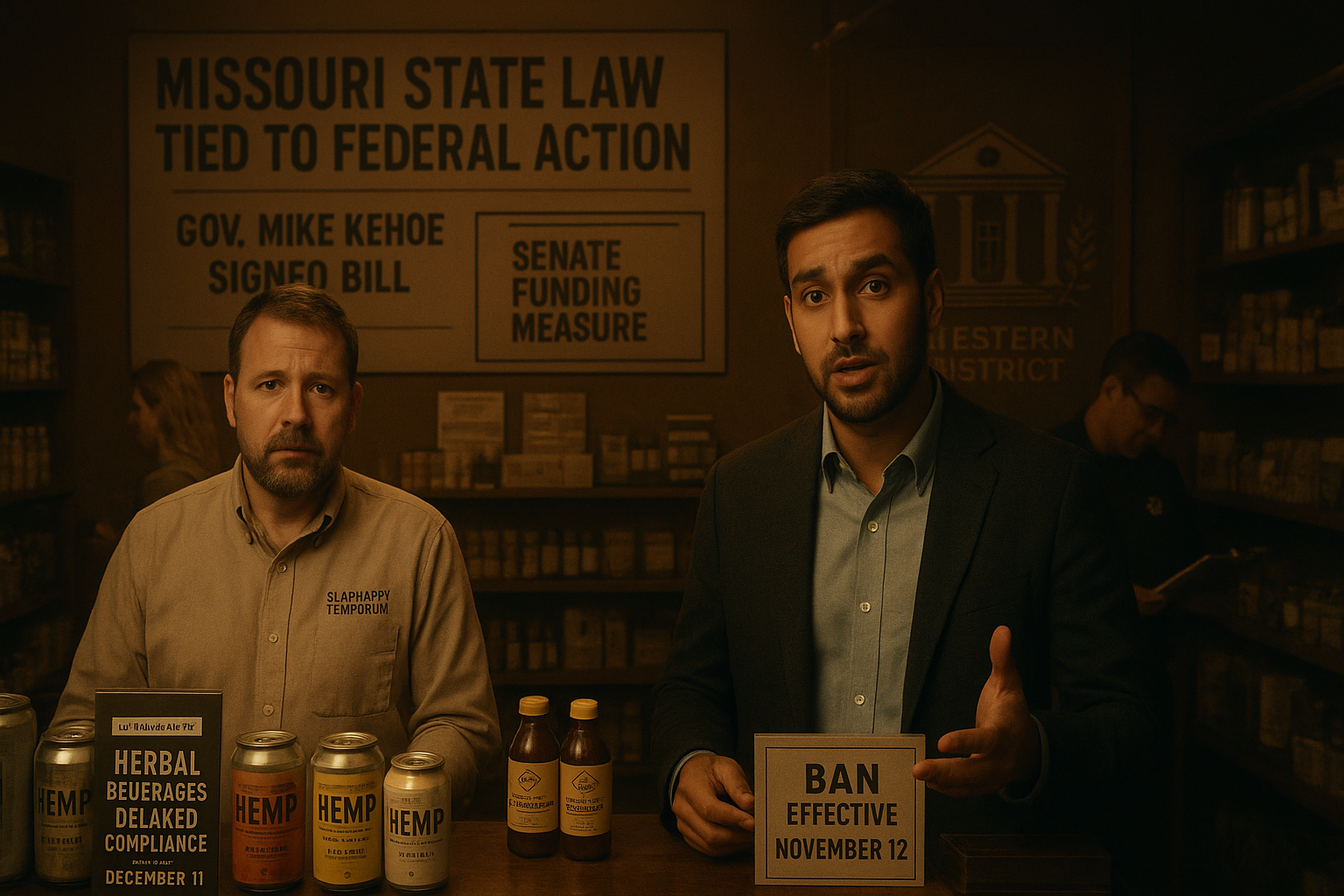
Missouri retailers stocking hemp-derived THC beverages got an unexpected reprieve this weekend, and the timing matters. The state's ban on intoxicating hemp products is scheduled to take effect Nov. 12, but a Senate-approved funding measure could push the parallel federal ban to Dec. 11 - and under Missouri's own statute, that federal delay would carry real weight on store shelves.
Here's the mechanism worth understanding: the bill Gov. Mike Kehoe signed this spring was written to mirror federal law, not operate independently of it. That drafting choice created a narrow carve-out. If Congress delays its ban, Missouri's ban on intoxicating beverages delays with it - though edibles, tinctures, and other hemp-derived THC products stay banned regardless of what happens in Washington. For operators running multi-category storefronts, that's a compliance headache with real inventory consequences. A shop that sells seltzers alongside gummies now has to manage two different regulatory clocks on the same shelf, which is the kind of split-SKU nightmare that keeps compliance officers up at night. It's also a reminder that retail infrastructure built for one category doesn't always transfer cleanly to another; operators watching how neighboring markets handle similar transitions, including those relying on dispensary pos oklahoma systems to manage mixed compliance requirements, know that point-of-sale configuration isn't a minor back-office detail here - it's the difference between a clean audit and a shelf full of unsellable product.
The bill still needs House approval and a presidential signature before Missouri retailers can breathe easy, and even then, "easy" is relative. Jay Patel of the Missouri Hemp Trade Association put it plainly: whatever Congress does won't fully solve the state's problems. That's not spin. A federal delay buys time, not certainty, and the hemp trade association's lawsuit - filed last month in the Western District, arguing the state law's hemp and marijuana definitions are unconstitutionally vague - is still working through the courts independent of what happens in Washington.
What a Split Ban Means for Operators
For a business like Slaphappy Hemporium in Rosebud, the practical effect is a company split down the middle. Owner John Grady's operation started as a beverage producer, so a delay on THC seltzers protects a meaningful chunk of revenue. But the rest of the catalog - edibles and other hemp products - faces the Nov. 12 cutoff no matter what Congress does. That's forced some Missouri retailers into a strange inventory dance: liquidating one category while restocking another, adjusting wholesale menus, and fielding customers who are, in Grady's words, already stocking up on items about to disappear. Any operator who's managed a sudden SKU discontinuation knows the drill - markdown shelving, updated compliant packaging requirements, and POS terminals reprogrammed to stop ringing up items that are, as of a specific date, no longer legal to sell.
The Regulatory Gap Nobody's Solved Yet
The deeper issue is that hemp-derived THC beverages have existed in a gray zone since the 2018 Farm Bill opened the door to hemp products with low delta-9 concentrations by dry weight. States have responded unevenly - some banning intoxicating hemp outright, others regulating it like adult-use cannabis, others doing nothing at all. Missouri's approach, tying its own ban to federal action, essentially outsources the timeline to Congress. That's a reasonable short-term fix, but it leaves retailers, distributors, and beverage producers unable to plan much past the next continuing resolution. A Dec. 11 deadline is not a regulatory framework; it's a pause button. Industry groups pushing for comprehensive federal rules during this window are betting that a few more months buys enough time to get durable standards - testing protocols, potency caps, labeling rules - in place before the next funding fight resets the clock again.
What This Means for the Shelf
For dispensary and hemp retail operators in Missouri, the near-term task is unglamorous but necessary: track both compliance deadlines separately, keep documentation current on which SKUs fall under which rule, and don't assume a beverage exemption protects anything else in the store. Consumer-facing signage and staff training should reflect that not everything hemp-derived is treated the same way under state law - a distinction that matters for age-restricted sales, product labeling, and avoiding inventory that becomes unsellable overnight. Whatever the House does next, the lesson for the trade is the same one Patel already flagged: a federal patch is not a Missouri solution.