
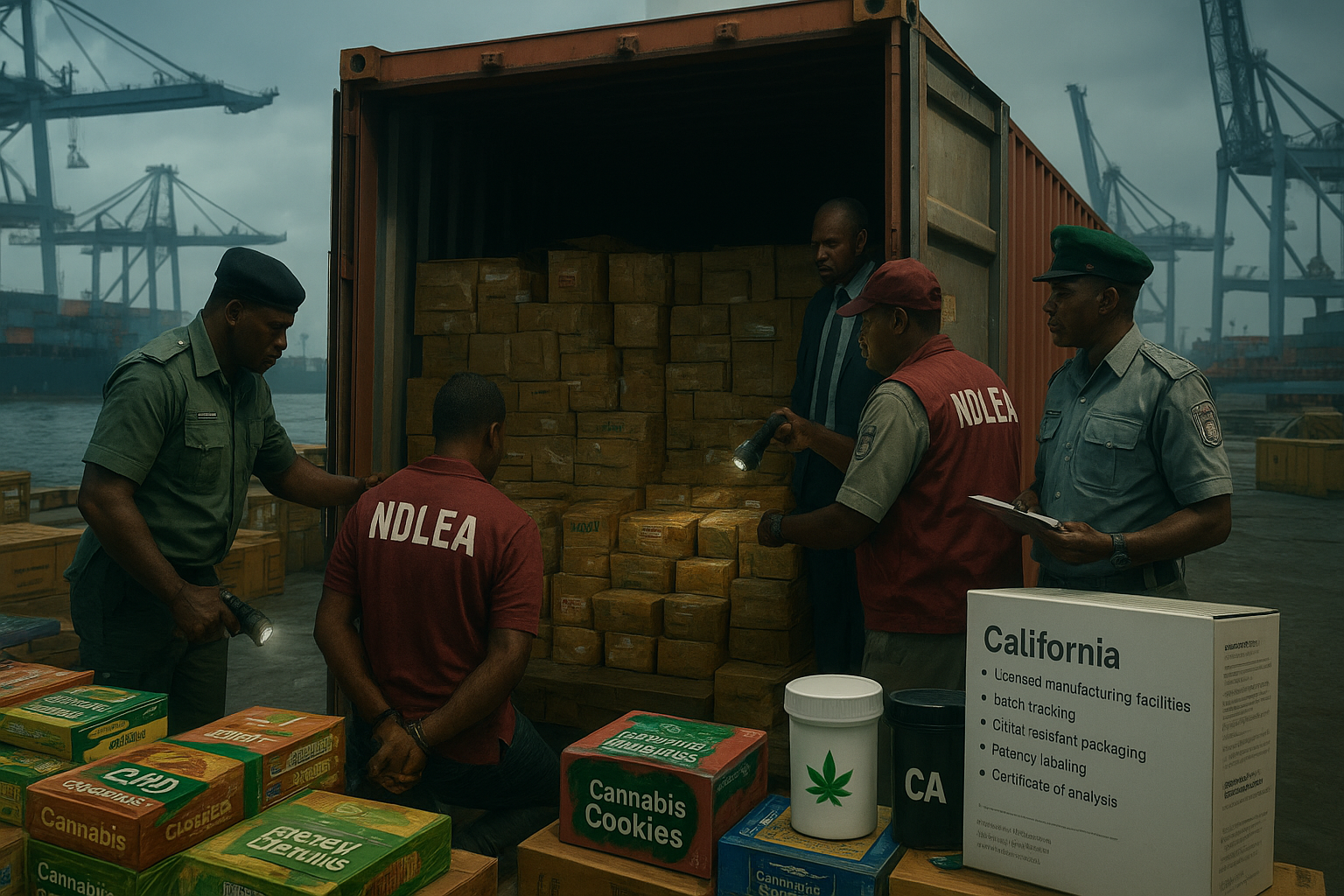
Nigerian counter-narcotics officers seized 442 packets of cannabis-infused cookies and gummies, weighing 309.4 kilogrammes, hidden inside a 40-foot shipping container at the TinCan Island Port Complex in Lagos. The consignment, discovered on August 4 during a joint inspection by the National Drug Law Enforcement Agency (NDLEA), the Nigeria Customs Service, and allied security units, involved 73 cartons of concealed confectionery. A suspect, Larry Nnaji, was arrested in connection with the find, according to a statement from NDLEA spokesman Femi Babafemi.
The seizure lands at an odd but instructive intersection for anyone watching the legitimate cannabis trade develop elsewhere. In regulated markets like California, edible products move through licensed manufacturing facilities under strict batch tracking, child-resistant packaging mandates, and lab testing requirements before they ever reach a dispensary shelf - a process that operators manage through platforms such as California cannabis POS systems, which log every unit from intake to sale. That kind of seed-to-sale visibility is precisely what's absent in cases like Nigeria's, where product provenance, potency, and contamination risk are all unknowns. The contrast is not subtle: one system runs on compliance logs and certificates of analysis, the other on concealment and guesswork.
Why Edibles Complicate Enforcement
Cannabis-infused cookies and gummies present a distinct enforcement problem compared to raw plant material. Packaging can mimic ordinary snack products, dosing is inconsistent without lab verification, and detection at ports often depends on tips or physical inspection rather than visual identification. That's part of why edibles have become a preferred format for traffickers moving product across borders - they blend in, and unlike jumbo bags of skunk or loose weed, they don't announce themselves by smell or shape alone.
For licensed markets, this is exactly why regulators lean so heavily on compliant packaging standards, opaque child-resistant containers, and mandatory potency labeling backed by a certificate of analysis. Without that infrastructure, an edible product carries no verifiable information about THC concentration, contaminants, or manufacturing origin - a real consumer-safety gap, not a theoretical one.
A Broader Pattern of Seizures
The TinCan Island find was one of several NDLEA operations logged between August 3 and August 8. In Oyo State, a raid on a warehouse in Elebure village recovered 731.03kg of illicit drugs and led to the arrest of Felicia Thompson; her alleged partner, Thompson Vincent Nwaka, remains at large. Edo State operatives, working with military support, recovered 65 jumbo bags of skunk weighing 604.5kg. Smaller but notable seizures followed in Abia State and Lagos, including the arrest of a wanted dealer, Adome Claude Sikuru, after a three-month manhunt.
- TinCan Island Port: 309.4kg of cannabis-infused edibles, one arrest
- Oyo State: 731.03kg of illicit drugs, one arrest, one suspect at large
- Edo State: 604.5kg of skunk recovered
- Abia State: 7kg of skunk, one arrest
- Lagos (Badagry): 88.5kg of skunk recovered from a long-sought suspect
What This Means for Legitimate Operators
None of this touches licensed cannabis retail directly, but it's a useful reminder of what regulation is actually built to prevent. Every compliance requirement that feels burdensome to a dispensary operator - inventory reconciliation, batch testing, packaging audits - exists precisely because the alternative is a market where nobody knows what's in the product or where it came from. NDLEA Chairman Brig. Gen. Mohamed Buba Marwa (retd.) framed the agency's approach as balancing enforcement with broader drug-control measures, a distinction that matters for policymakers watching how different countries handle the same underlying substance through very different regulatory lenses.