
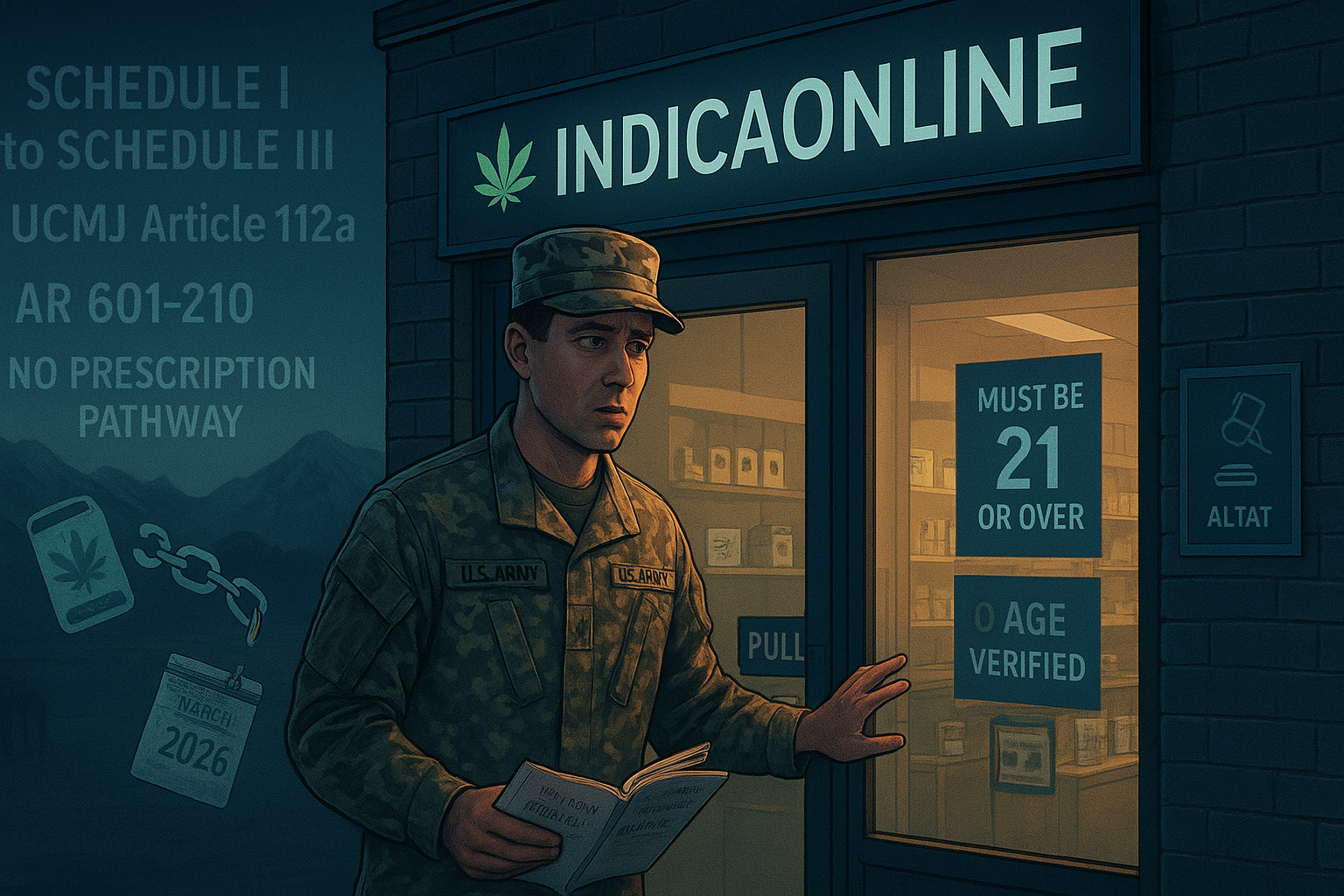
The federal reclassification of marijuana from Schedule I to Schedule III - finalized through a Justice Department and Drug Enforcement Administration order - has generated real confusion among service members stationed in states where adult-use cannabis is legal. The short answer is this: rescheduling changes nothing for uniformed personnel. Military policy has not moved an inch, and the legal exposure for cannabis use remains exactly what it was before the reclassification order.
This distinction matters in states where regulated cannabis markets have expanded significantly, and where dispensary operators, compliance officers, and cannabis retailers operate under state licensing frameworks that are entirely separate from federal military law. In markets like Alaska, where adult-use dispensaries function under state regulatory authority - and where point-of-sale compliance tools such as IndicaOnline in Alaska help licensed operators manage inventory, age verification, and seed-to-sale tracking requirements - the legal retail infrastructure exists and functions. But that infrastructure carries no protective weight whatsoever for a service member who purchases or consumes cannabis in those stores. State-legal purchase does not equal federally lawful conduct for someone subject to the Uniform Code of Military Justice.
Here's the core mechanism. Article 112a of the UCMJ prohibits wrongful use, possession, and distribution of controlled substances classified under Schedules I through V - not Schedule I alone. That's the detail most service members miss. Even under Schedule III, marijuana without a valid federal prescription remains a controlled substance. Use or possession without that prescription is a punishable offense, and the potential consequence is court-martial. The rescheduling order did not create a prescription pathway for service members through military medicine; it simply moved cannabis to a less restrictive scheduling tier for civilian regulatory purposes.
What Rescheduling Actually Changed - and What It Didn't
Schedule III designation is meaningful in the civilian and commercial context. It signals that a substance has recognized medical utility and lower abuse potential than Schedule I or II drugs - a threshold cannabis advocates have argued for decades. For the licensed cannabis industry, the reclassification carries potential implications for research access, pharmaceutical development, and, eventually, federal tax treatment. But the UCMJ operates on its own authority, independent of DEA scheduling logic. The code prohibits wrongful use of any federally scheduled substance in categories I through V. Moving cannabis from one prohibited tier to another doesn't exit it from the list.
Medical marijuana is no exception here. Even with a state-issued medical cannabis card or a physician recommendation, a service member has no legal protection under military law. There are no command-level exemptions. There are no medical exceptions built into Article 112a for cannabis specifically. To put it plainly: a valid prescription from a civilian doctor for a state-medical marijuana program does not constitute authorization under the UCMJ. That gap is significant - and it is not addressed by rescheduling alone.
Relaxed Enlistment Rules Don't Signal a Policy Shift Inside the Ranks
The military has, in recent years, adjusted its posture on pre-enlistment marijuana history. A March 2026 update to U.S. Army enlistment eligibility regulations (AR 601-210) removed the waiver requirement for individuals with a single prior conviction for marijuana possession or drug paraphernalia possession. That's a meaningful administrative change, one that reflects broader social and political pressure as more states legalize adult use and more Americans carry cannabis-related records.
What it does not reflect is any tolerance for in-service use. The Army's zero-tolerance policy on marijuana use by active service members remains in force under AR 601-210 and is enforceable through the UCMJ. Easing the door for new recruits with prior records is a separate question from what conduct is permitted after the oath is administered. The two should not be read together as a relaxation of standards for current personnel.
The Practical Risk for Service Members and Their Advisors
Military personnel who have used cannabis, failed a drug test, or are under investigation for a marijuana-related offense face serious legal exposure. Non-judicial punishment under Article 15, administrative separation, and court-martial are all live possibilities depending on the circumstances. The standard advice from military legal professionals is clear: do not make statements to commanding officers or investigators without consulting a military attorney first. Accepting non-judicial punishment without legal counsel can foreclose options that might otherwise be available.
The broader takeaway for anyone working in or adjacent to regulated cannabis retail - dispensary operators, compliance teams, budroom staff - is worth keeping in mind. State-legal cannabis markets operate under robust licensing and compliance requirements, and licensed dispensaries have no obligation to screen military customers differently than civilian ones. But service members purchasing from compliant, licensed retailers in adult-use states are not insulated from military law. The compliance frameworks that govern dispensary operations - age verification, purchase limits, packaging and labeling requirements - exist to satisfy state regulatory obligations. They do not create any shield against federal military law for the buyer.
Rescheduling was a significant regulatory event. For service members asking whether it changes their situation - it doesn't. Not yet, and possibly not without a direct amendment to the UCMJ or a formal military policy revision that no branch has issued.
This article is for informational purposes only. Its content is not intended to constitute legal advice, nor does it establish a client-lawyer relationship with any legal entity.