
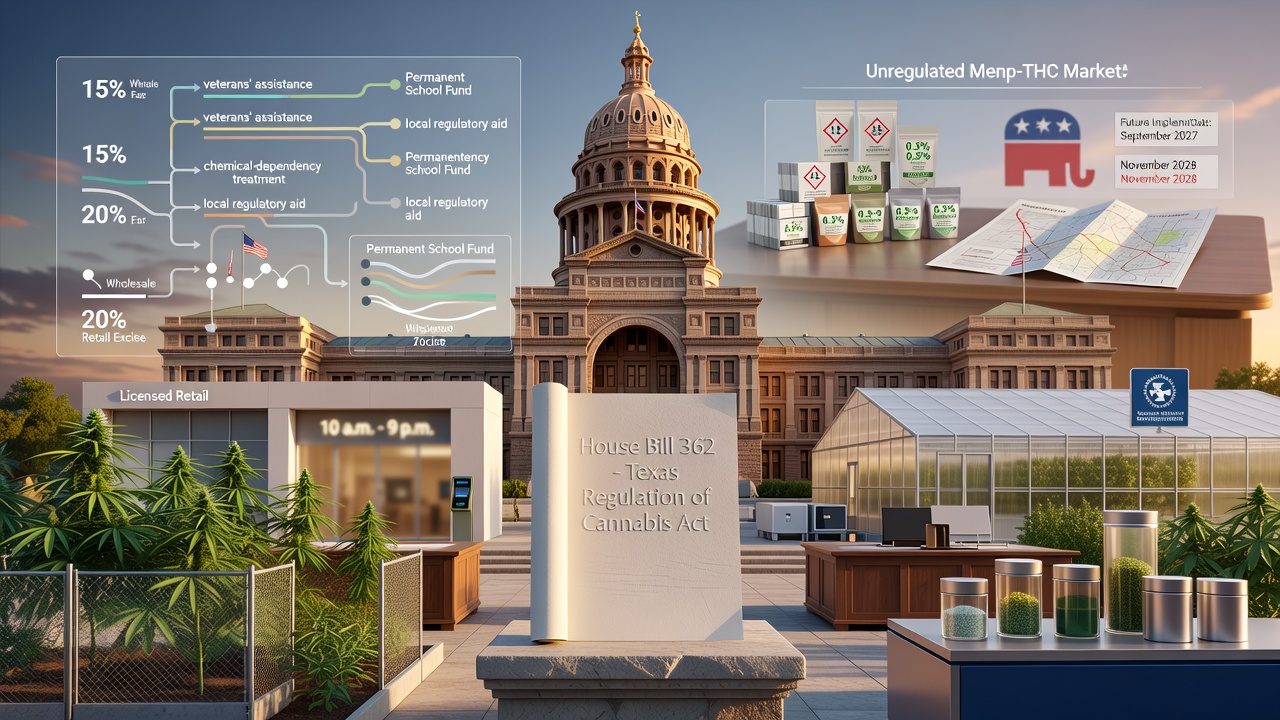
State Rep. John Bucy III, an Austin Democrat, filed House Bill 362 on the first day of bill filing for the 90th Texas Legislature, proposing what would be the state's first regulated adult-use cannabis market. The Texas Regulation of Cannabis Act goes well beyond the hemp-THC skirmishes that have dominated Texas cannabis policy in recent cycles - it would legalize possession, home cultivation and licensed retail sale for adults 21 and older. For an industry that has operated almost entirely in hemp's regulatory shadow, this is a different conversation entirely.
What the bill actually sets up
HB 362 draws a clean legal line between cannabis and hemp, a distinction current Texas law blurs by regulating delta-9 concentration rather than plant source. Adults could possess up to two ounces of cannabis, with a 15-gram cap on concentrate within that total, and grow as many as 12 plants at a private residence under security and visibility restrictions. The bill also permits possession of an additional 10 ounces produced from home grows, provided operators meet added storage requirements once quantities exceed two ounces - a tiered compliance structure not unlike what multi-state operators already navigate in states with home-grow allowances.
On the commercial side, the bill would stand up a full licensing structure for growers, transporters, testing facilities and retailers under the Texas Department of Licensing and Regulation - not a cannabis-specific agency, which is itself worth flagging. Retailers would operate within set hours, 10 a.m. to 9 p.m., with strict age-gating at the door. Local governments would retain authority over zoning, hours and the number of licensed locations, but could not block cannabis commerce outright - a familiar tension for operators who've dealt with municipal opt-outs in other adult-use states.
Tax structure and where the money goes
The bill layers a 15% tax on wholesale transactions between growers and cannabis establishments on top of a 20% retail excise tax, both in addition to standard sales tax. That's a meaningfully different cost stack than what hemp-derived THC sellers face today, and it would force real decisions around wholesale pricing, margin modeling and point-of-sale tax configuration if the bill ever reaches implementation. Revenue would flow to veterans' assistance, chemical-dependency prevention and treatment, local regulatory assistance and the Permanent School Fund - a revenue-allocation model that mirrors how several other states have sold legalization to skeptical legislators.
The compliance runway is long by design. Even in the most favorable scenario - passage, a governor's signature, implementation - the law wouldn't take effect until September 2027. Rulemaking would extend to July 2028, with licensing not beginning until November 2028. For anyone in the hemp-THC trade thinking about pivoting, that's a multi-year horizon, not a near-term shift.
Why the odds remain long
The bill arrives amid a notable political shift - Democrats prepared to hold the governor's office and lieutenant governor's office - but Republicans retain their Senate majority, and the lieutenant governor controls what the Senate takes up. Texas has consistently resisted adult-use legalization even as neighboring states moved forward, and current law still treats delta-8 and related cannabinoids as controlled substances while capping hemp products at 0.3% delta-9 THC by dry weight under state health department testing rules. HB 362 doesn't repeal that hemp framework; it would run alongside it, which raises its own compliance questions about how retailers would differentiate hemp-derived inventory from newly licensed cannabis products on the same shelf.
For operators and suppliers watching Austin, the practical takeaway isn't that legalization is imminent. It's that the regulatory architecture - tax tiers, licensing categories, testing requirements, local control provisions - is now on paper and in public debate, which gives the industry something concrete to react to, lobby around, or plan contingencies against, even if passage this session is far from assured.