
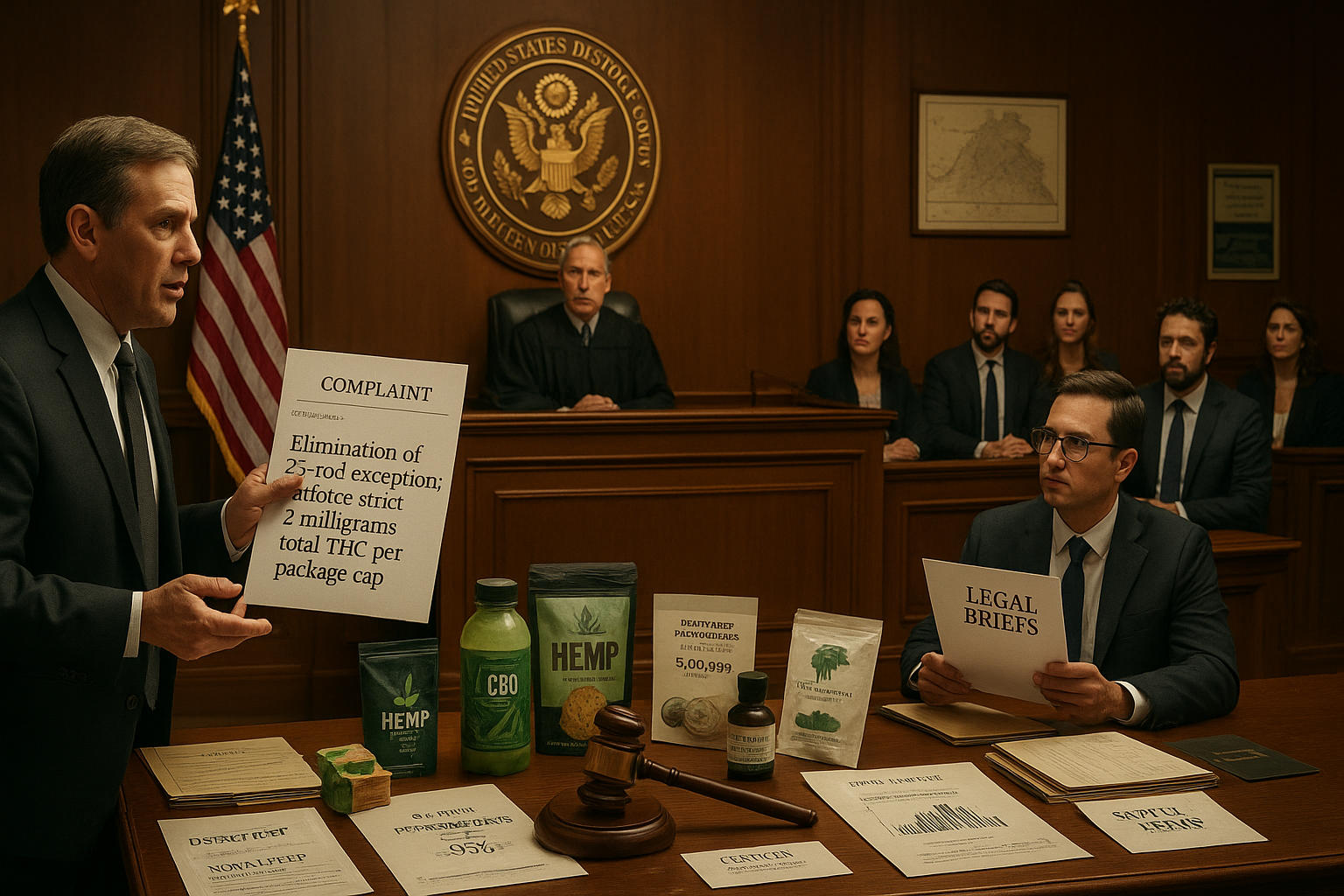
Seven Virginia hemp businesses filed suit July 31 in the U.S. District Court for the Western District of Virginia, asking a judge to block a new state budget provision that eliminates the so-called 25-to-1 exception for consumable hemp products. Without that carve-out, products sold in the commonwealth will be capped at 2 milligrams of total THC per package, regardless of how much CBD they contain, once the rule takes effect August 15. The plaintiffs - including District Hemp Botanicals, Nova Hemp & Agriculture, Redfern Hemp Co., Pure Elkton Manufacturing, Cypress Hemp II, Wellness Warriors and Simply Hemp - say the change will strip much of their inventory of legal status overnight, with almost no runway to adjust.
That compressed timeline is the part that stings operationally. Businesses received formal notice on July 6 that the exception would disappear, leaving roughly 40 days to reformulate products, redesign packaging, renegotiate manufacturing contracts and dispose of stock that no longer qualifies for sale. For context, that's a tighter window than most retail operators get to swap out a point-of-sale vendor or retrain staff on new compliance logs - and this involves rebuilding entire product lines. Retailers across regulated cannabis markets know the drill: inventory management, batch tracking and SKU-level compliance require lead time, not a six-week scramble. States building out adult-use frameworks elsewhere have leaned on infrastructure like cannabis pos systems south dakota operators use to keep seed-to-sale data aligned with shifting rules - a reminder that regulatory whiplash isn't unique to Virginia, even if the stakes here are especially blunt.
The lawsuit's core legal theory is that Virginia is taking private property without compensation and denying due process by changing the regulatory structure with no transition period, no sell-off window and no offsetting relief. District Hemp reports about $10,000 in now-unsellable inventory against more than $181,000 in outstanding obligations to creditors. Cypress Hemp says the affected products make up roughly 95 percent of its revenue. Redfern Hemp estimates losses between $110,000 and $115,000, and Simply Hemp projects a hit of about $225,000 this year, enough to force the closure of its Collinsville location. Those aren't abstract figures on a spreadsheet - they translate directly into layoffs, terminated leases and, in at least one case cited in the filing, bankruptcy.
Why Virginia Is Tightening the Rules Now
State officials frame this differently. A spokesman for Gov. Abigail Spanberger said intoxicating hemp products have spread through vape shops and convenience stores that never had to meet the testing, packaging and age-verification standards required of licensed marijuana dispensaries. That's a legitimate consumer-safety argument on its face: unregulated retail channels selling THC-infused beverages and edibles alongside snacks and gas-station goods is a genuine gap in oversight, and it's one several states have moved to close. Attorney General Jay Jones has said his office is prepared to defend the new framework, calling it a set of "clear standards" paired with enforcement tools aimed at the illicit market.
The catch is timing. Virginia's adult-use marijuana retail market, which will fold hemp regulation under the Virginia Cannabis Control Authority, isn't scheduled to open until July 1, 2027. That leaves close to two years where consumers who previously bought a moderately dosed CBD-forward beverage will have no regulated substitute - a gap advocates like Marijuana Justice's Chelsea Higgs Wise warn could push demand toward the unregulated market instead of shrinking it.
A Familiar Pattern Across State Hemp Markets
Virginia isn't inventing this fight. California banned detectable THC in food, beverages and supplements through emergency rules and later reported broad compliance after inspecting thousands of businesses. Minnesota took the opposite approach, setting per-serving and per-package THC caps alongside testing and labeling requirements rather than banning the category outright. Texas moved toward prohibition after its supreme court upheld regulators' authority to treat delta-8 as a controlled substance. Federal policy is tightening too: a provision signed into law last year sets a 0.4-mg total THC limit per container for finished hemp products starting November 12, well below even Virginia's new 2-mg threshold, though the administration has since signaled openness to revisiting the definition of hemp with Congress.
What Comes Next for Operators
The plaintiffs aren't necessarily asking the court to preserve the status quo forever - they're asking for time. An injunction, Biddle said, would let lawmakers reconsider the restriction or work out compensation for businesses that built inventory, leases and staffing around the 25-to-1 rule now being erased. For dispensary operators, brands and wholesalers watching from other states, the case is a pointed reminder that regulatory frameworks built around ratios, milligram caps and concentration limits can shift fast, and that compliant packaging or a clean certificate of analysis offers no protection once the underlying legal category itself is redefined.