
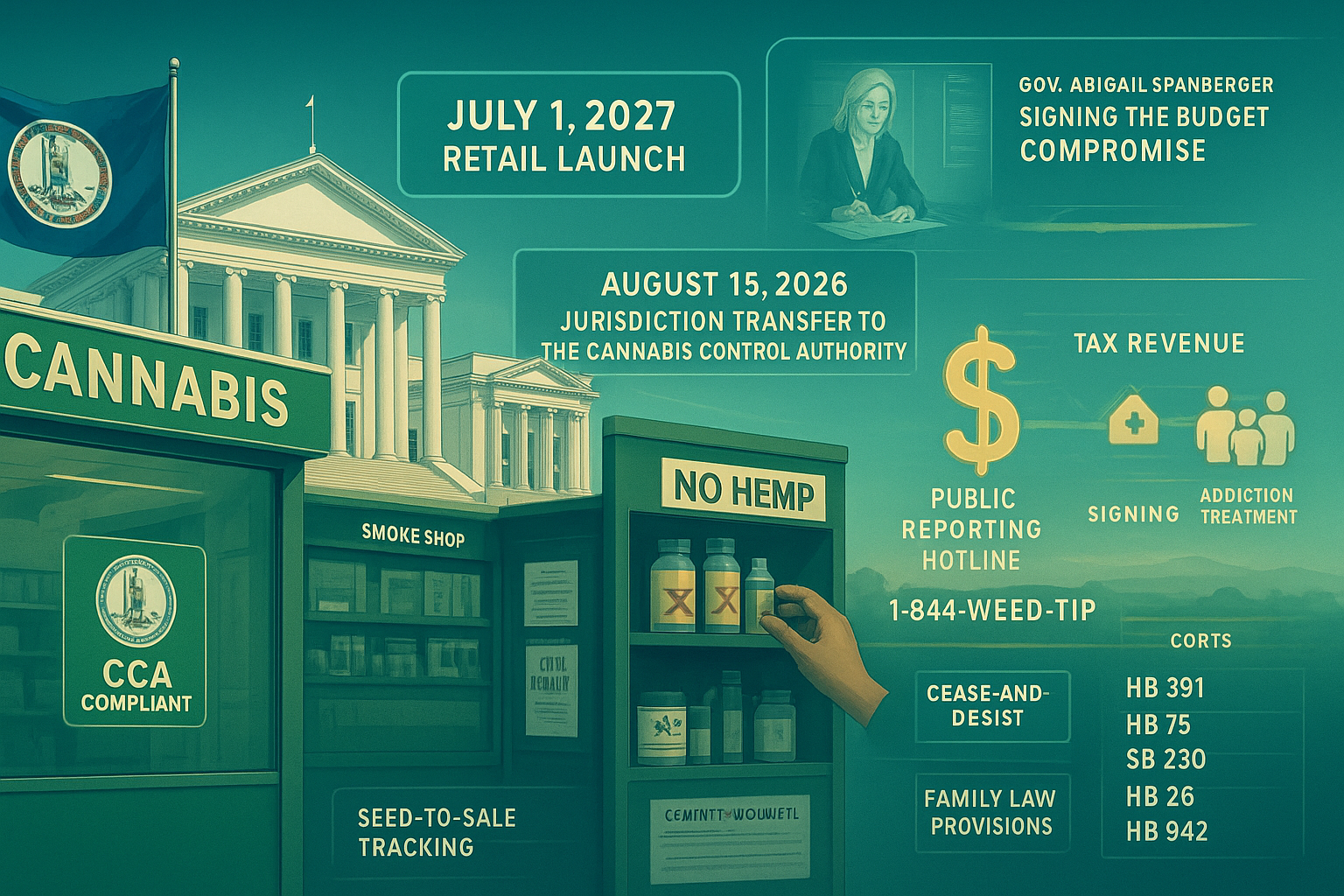
Virginia has locked in its path to a regulated adult-use cannabis market - and the first major deadline arrives well before any dispensary opens its doors. Following a budget compromise between the General Assembly and Governor Abigail Spanberger, the Commonwealth's Cannabis Control Authority (CCA) has published a finalized framework covering the rollout timeline, product restrictions, enforcement authority, and public accountability mechanisms for the state's licensed retail cannabis market, set to open July 1, 2027.
The practical weight of these changes will hit operators and retailers considerably sooner. Starting in August 2026, regulatory jurisdiction over all hemp-derived products transfers from agricultural oversight entirely to the CCA - a structural shift that rewrites the compliance environment for any business currently selling hemp consumables in the state. For dispensary operators and hemp retailers preparing inventory decisions, software configurations, and staff training schedules, that transition date is the real operational starting gun. Platforms like IndicaOnline cannabis POS illustrate how point-of-sale systems built for compliant cannabis retail handle exactly this kind of regulatory jurisdiction shift, where SKU-level product eligibility, potency thresholds, and labeling requirements can change in ways that affect every transaction at the register.
The 25:1 Loophole Closes August 15, 2026
Here's the provision that will immediately reshape shelves across Virginia: on August 15, 2026 - two weeks after the CCA assumes hemp oversight - the state will enforce a hard cap of two milligrams of total THC per package on any product sold as a hemp product. The rule eliminates what regulators have termed the "25:1 loophole," which previously permitted hemp products to exceed two milligrams of THC provided the product maintained a 25:1 ratio of CBD to THC.
That ratio-based standard, to put it plainly, had become a commercially exploited pathway. Products carrying meaningful psychoactive potency were marketed and sold in general retail - convenience stores, smoke shops, wellness boutiques - entirely outside the licensed cannabis framework. Closing it means any product exceeding that two-milligram threshold can no longer be legally produced or sold as a hemp product in Virginia. Retailers currently carrying high-ratio hemp consumables face a hard inventory reckoning before that date. Products that don't meet the new standard either get pulled or constitute a violation.
Senate Bill 543 arms the CCA to act on exactly that scenario. The authority now holds power to issue immediate notices of violation, levy civil penalties, and hand down cease-and-desist orders to unlicensed operations - without waiting for a lengthy adjudicative process. A public reporting mechanism adds another enforcement layer: residents can flag suspected illegal commercial activity online or through a dedicated hotline at 1-844-WEED-TIP. Licensed retailers, meanwhile, will be required to display an official state-issued compliance decal in their storefront windows. That decal distinction matters - it gives consumers, enforcement agents, and neighboring businesses a visible signal of which operations are operating inside the legal framework and which are not.
What the 2027 Market Structure Means for Operators
The July 2027 retail launch is the longer horizon, but the regulatory architecture being laid now will define what that market looks like when it opens. Tax revenues generated by the adult-use market are legally designated for public education, health care initiatives, addiction treatment, and communities historically most affected by drug enforcement. That earmarking structure is standard among states that have built equity considerations into their cannabis frameworks - it also sets a political expectation that the market perform well enough fiscally to fund those commitments.
For operators evaluating Virginia as a market entry or expansion opportunity, the timeline carries real planning implications. Licensing processes, facility buildouts, compliance systems, seed-to-sale tracking integrations, and staff hiring typically require 12 to 18 months of lead time in regulated cannabis markets. With the CCA now consolidated as the single regulatory authority - covering both the hemp transition and the forthcoming adult-use licensing regime - operators have one point of contact for compliance, which can simplify communication but also concentrates regulatory risk if the agency's capacity is stretched during implementation.
Additional Legislative Changes Already in Effect
The retail framework isn't the only thing that changed. Several companion bills have moved into law alongside the market timeline. House Bill 391 and House Bill 75 expand medical cannabis access specifically for terminally ill patients - a relatively narrow but meaningful expansion of the patient population eligible for medical program access. On the criminal justice side, Senate Bill 230 and House Bill 26 establish expungement pathways for certain past marijuana-related convictions and create mechanisms to modify prior sentences. House Bill 942 addresses parental rights in the context of legally authorized substance use - a provision that reflects how legislatures in adult-use states increasingly contend with family law implications of cannabis legalization.
Existing hemp retailers will receive direct outreach from the state about registration renewals as the CCA transition approaches. What's worth watching between now and August 2026 is how aggressively the CCA moves to stand up its enforcement capacity - the loophole closure only matters in practice if the agency can back it up. Virginia's retail cannabis market, when it does open, will enter with more regulatory infrastructure in place than many states managed at launch. Whether that translates into a clean, well-functioning opening depends on how much groundwork the CCA lays in the months ahead.