
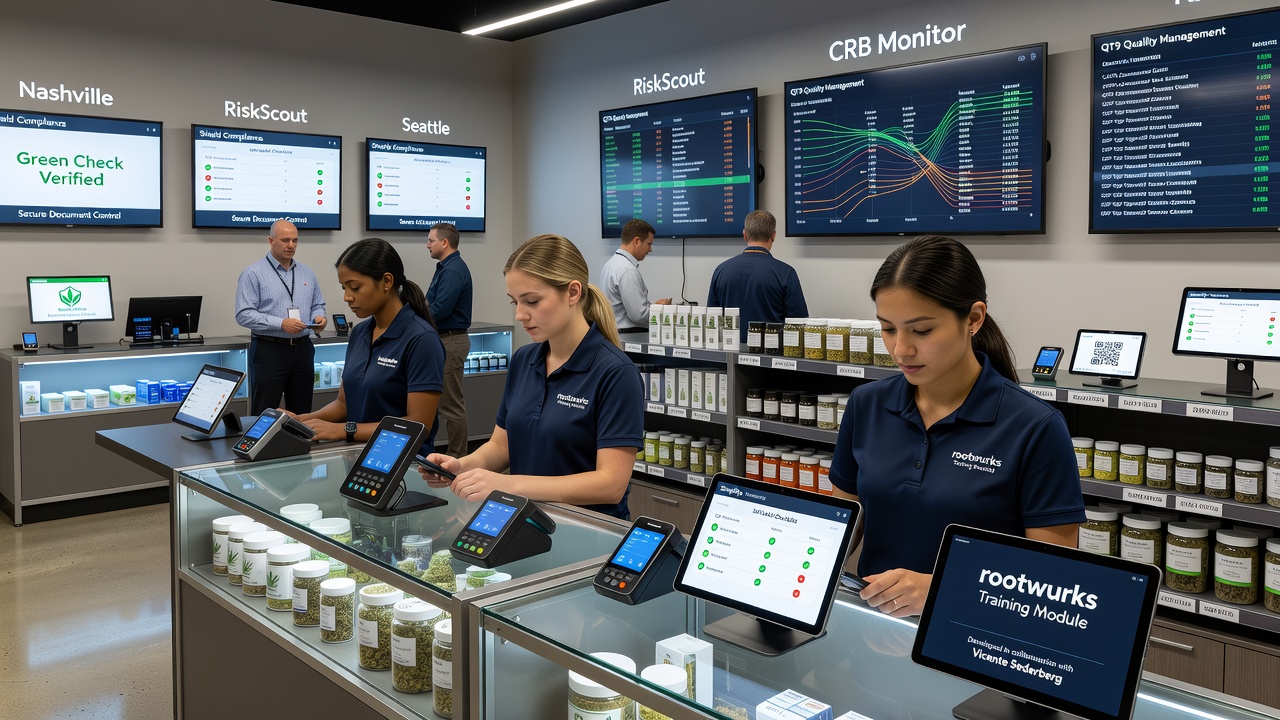
Running a clean inventory count is no longer enough to keep a dispensary license in good standing. Regulators and banks increasingly want proof - documented, timestamped, and retrievable on demand - that an operator trains staff, audits itself, and enforces purchase limits at the register. A separate category of software has emerged to supply that proof, distinct from the seed-to-sale and track-and-trace platforms that handle plant movement and state reporting.
Self-Audits, SOPs and the Paper Trail Regulators Expect
Simplifya, based in Lakewood, Colorado, builds its platform around self-audits, standard operating procedure management, and license tracking across the states it covers. The logic here is straightforward: an inspector who shows up unannounced wants to see that a dispensary has already found its own problems, not waited to be told. Rootwurks, out of Austin, pairs training courses with checklists and assessments developed alongside the cannabis law firm Vicente Sederberg - a detail that matters because SOPs written without legal input tend to age poorly as rules shift state by state.
What's striking here is how much of this work used to live in binders. Budtender training logs, manager sign-offs, incident reports - all of it was paper, scattered across store locations, and nearly impossible to produce quickly during an inspection. Digitizing that record isn't glamorous. It is, however, the difference between a clean inspection and a cited violation that threatens a license renewal.
Quality Management and the Manufacturing Side of Compliance
QT9 sells a quality management system aimed at cannabis manufacturers, covering document control, corrective and preventive action (CAPA), audits, and training records. This matters more as vertically integrated operators expand into edibles, concentrates, and other manufactured goods, where a single mislabeled batch or skipped quality check can trigger a recall and real reputational damage. Lab testing and the certificate of analysis get the attention in consumer-facing conversations; the quality management layer behind them - who signed off, when, under what protocol - is what regulators actually audit.
ID Checks and Purchase Limits at the Counter
Patronscan's ID scanning technology flags repeat visits, which helps dispensary staff respect daily purchase limits - a rule that exists to curb both underage access and gray-market diversion. In practice, though, a budtender at a busy counter cannot reliably track whether a customer already bought the daily legal limit somewhere else in town. Software that flags rapid repeat visits closes a gap that pure trust-based compliance never could.
Metrc, the state-contracted track-and-trace system used in many markets, still shows up on this list because license and compliance tools frequently plug into its data, even though inventory movement itself is covered elsewhere.
The Bank's Side of the Ledger
Cannabis businesses keep their bank accounts because the bank can document due diligence - not because the business itself asks nicely. Green Check, headquartered in Bonita Springs, Florida, along with Shield Compliance in Seattle and RiskScout, give banks and credit unions onboarding, ongoing monitoring, and reporting tools built specifically for cannabis accounts. CRB Monitor, based in Nashville, maintains a database of cannabis licenses and beneficial ownership information used for know-your-customer checks.
This is the part operators sometimes miss: an owner may never choose one of these platforms directly. They meet it anyway, the moment they open a business checking account, because the bank's compliance team is running it quietly in the background. Federal law still treats cannabis as a Schedule I substance, and 280E continues to limit standard business deductions - which is exactly why banks lean so heavily on documented monitoring before they'll touch a cannabis account at all.