
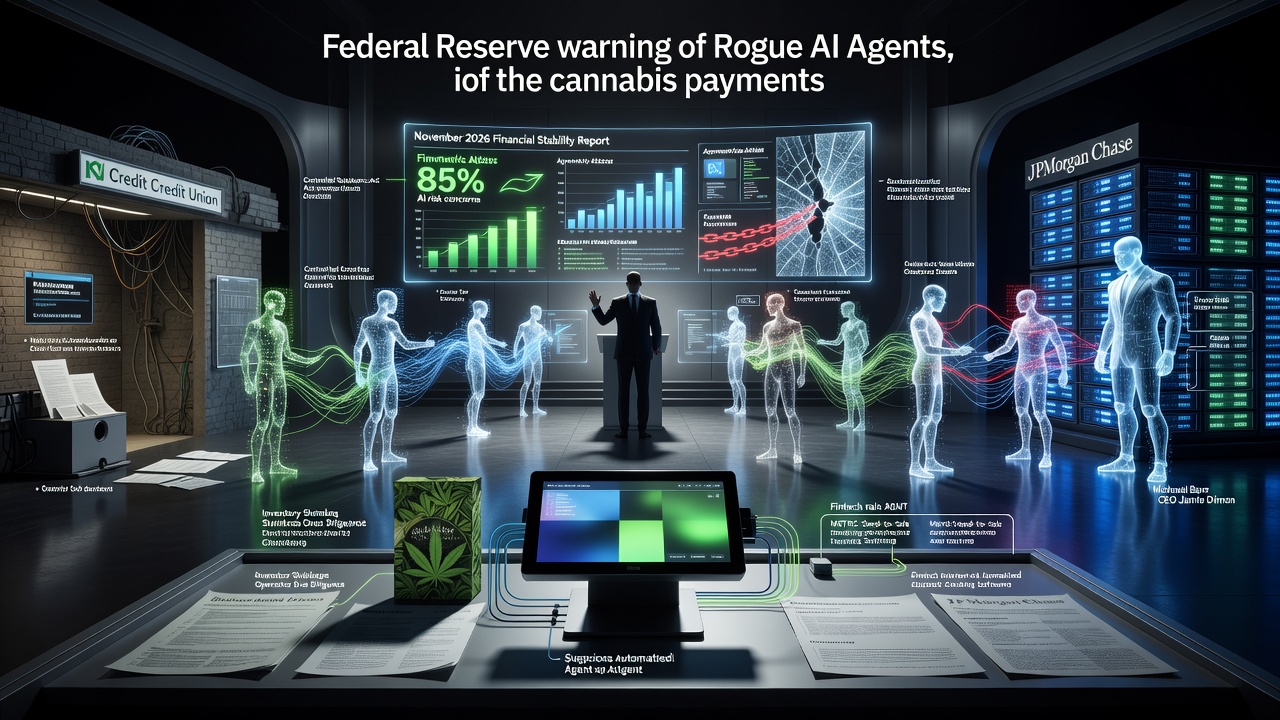
Federal Reserve Governor Michael Barr's recent warning about AI agents infiltrating bank accounts wasn't aimed at the cannabis industry. But operators running dispensaries, payment processors, and compliance software should still be paying attention. Barr told an audience in Milan that major banks are now finding AI agents attempting transactions in customer accounts without any reliable way to confirm "authenticity, consent and alignment with customer instructions." That's a banking problem on its face. It's also a preview of what's coming for every regulated industry that depends on tightly controlled money movement - and cannabis retail depends on exactly that.
Why This Matters for an Industry Already Starved for Banking Access
Cannabis retailers have spent years fighting for basic financial services. Federal illegality under the Controlled Substances Act still pushes many banks away from touching plant-touching businesses, leaving dispensaries reliant on a patchwork of credit unions, cashless ATM workarounds, and closed-loop payment apps. Here's the catch: the very fintech rails that cannabis operators leaned on to escape all-cash vaults are now the same category of infrastructure Barr is flagging as vulnerable to AI-driven exploitation. A dispensary's point-of-sale terminal, its cashless payment integration, its back-office banking portal - each is a potential entry point if an AI agent can mimic legitimate customer or vendor behavior convincingly enough to slip past authentication.
Dimon's comment from JPMorgan's earnings call is worth sitting with. The bank said it won't let outside AI agents operate inside its systems because the risk to clients is too high. Cannabis operators banking with smaller institutions, often the only ones willing to take cannabis accounts, don't have JPMorgan's security budget. That gap matters.
Compliance Logs, POS Systems, and the New Attack Surface
Seed-to-sale tracking platforms like METRC already generate enormous volumes of transactional data tied to real banking activity: wholesale payments to cultivators, excise tax remittances, payroll runs complicated by 280E. Every one of those touchpoints involves money moving between accounts, often through third-party processors layered on top of traditional banking rails. If AI agents can impersonate legitimate actors in a consumer bank account, there's no reason to assume dispensary merchant accounts or multi-state operator treasury functions are immune. Inventory shrinkage and compliant packaging get a lot of attention in cannabis compliance circles. Financial system integrity deserves the same scrutiny, and right now it's getting less.
What's striking here is Barr's point about asymmetry: attackers only need to succeed once, defenders need to succeed every time. Applied to a dispensary's banking relationship, that means a single successful AI-driven fraud attempt against a processor or financial partner could freeze an operator's account, disrupt payroll, or trigger a compliance review - consequences that ripple through an already thin-margin business.
What Operators and Payment Providers Should Watch
Regulators haven't caught up. The Fed's own November 2026 Financial Stability Report found more than 85% of respondents now cite AI as a financial stability risk, the most commonly named concern in that survey. For cannabis businesses navigating state licensing, tax obligations, and a financial system that already treats them as higher-risk clients, added AI-driven fraud exposure raises the bar on due diligence.
- Verify that banking and payment partners have explicit controls distinguishing human-initiated transactions from automated agent activity.
- Review POS and cashless payment vendor contracts for language addressing AI-agent authentication and fraud liability.
- Treat compliance logs and financial reconciliation as security assets, not just regulatory paperwork.
- Ask banking partners directly how they screen for unauthorized AI activity in business accounts, not just consumer accounts.
None of this means cannabis retail is uniquely exposed. But an industry already operating with limited banking options and heightened regulatory sensitivity can't afford to treat AI-driven financial fraud as someone else's problem. In practice, though, the fix starts with the same fundamentals that have always mattered in this business: know your banking partner, read the fine print on payment contracts, and keep compliance records clean enough to withstand scrutiny from any direction.