
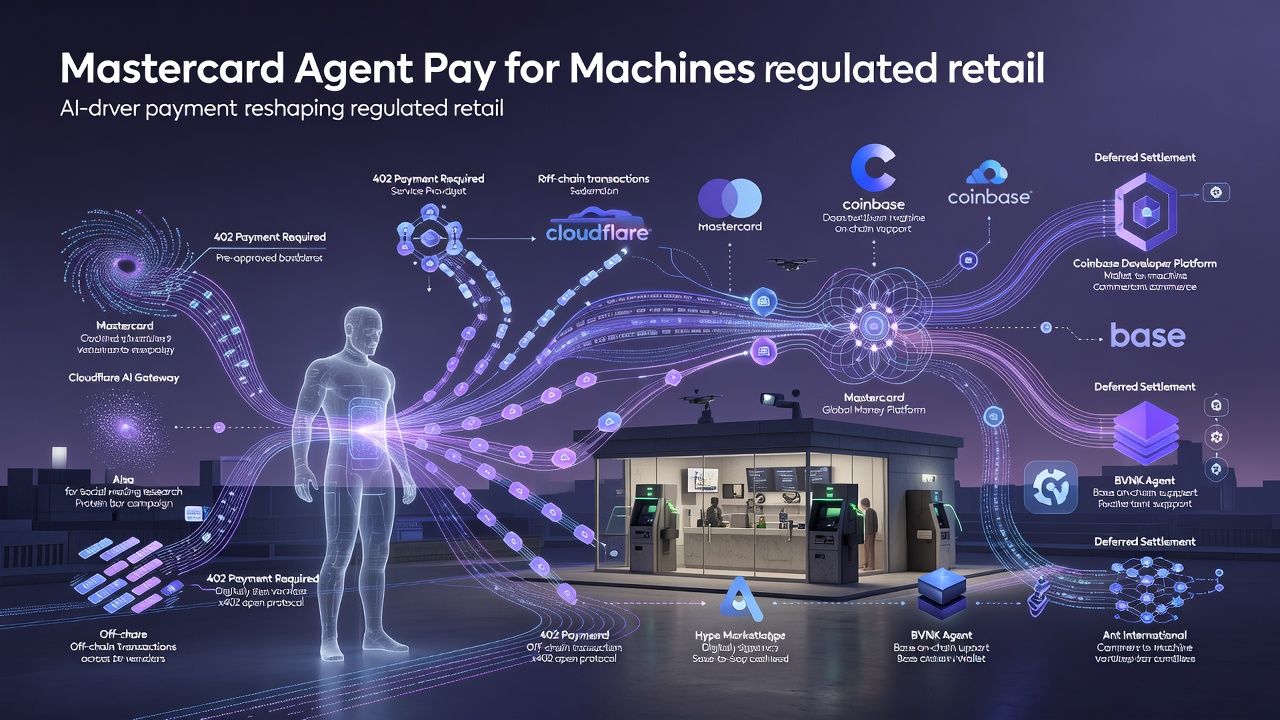
Mastercard has demonstrated a system that lets AI agents pay multiple service providers automatically under one pre-approved budget, without separate accounts, API keys or invoices for each transaction. The company showed off its Agent Pay for Machines tool at Cloudflare Connect, following pilot work with Cloudflare, Ant International, AIsa, Base, BVNK, Coinbase and Hype. It has also opened early access so developers can start building payment applications on top of it.
For an industry like cannabis retail that already runs on tightly controlled payment rails - cashless ATM workarounds, closed-loop systems, state-mandated seed-to-sale tracking tied to every transaction - any shift in how automated payments get verified and settled is worth watching, even if the pilot itself has nothing to do with dispensaries.
How the Payment Mechanism Actually Works
The system builds on x402, an open protocol that lets digital services request payment in real time. Here's the basic flow: a business assigns an AI agent a task and sets a spending ceiling. When the agent hits a paid service, the provider returns a "402 Payment Required" response - an old HTTP status code that's existed for decades but rarely got used this way. The agent then generates a digitally signed payment voucher. Once the provider verifies it, the service gets delivered.
What's notable is that these transactions settle off-chain. Providers can batch and collect vouchers, then redeem them later rather than clearing each payment the moment it happens. In the demo, marketing agency Hype ran an AI agent through a sample campaign for a protein bar launch - the agent bought social media research from AIsa and generated eight campaign images through Cloudflare's AI Gateway, completing nine separate payments across two providers under a single authorization. Coinbase Developer Platform handled wallet infrastructure, Base supported on-chain settlement, and BVNK served as the agent wallet, using Mastercard's Global Money Platform to settle in either fiat currency or stablecoins.
Why This Matters for Regulated Businesses
Cannabis operators know better than most industries how payment infrastructure can make or break daily operations. Federal banking restrictions have forced dispensaries into cash-heavy workflows, workaround ATM systems, and compliance logs that track every dollar against state tax and licensing requirements. A protocol that automates multi-vendor payments under one budget - verified, logged, and settled through a defined wallet structure - is exactly the kind of architecture that regulated industries with heavy reporting burdens eventually end up watching closely, even when the pilot use case is marketing spend for a protein bar.
That said, nothing here suggests Mastercard built this with cannabis in mind, and the company's existing restrictions on cannabis-related transactions remain unchanged. Dispensary owners and multi-state operators shouldn't read this as a signal that major card networks are loosening their stance on plant-touching businesses. If anything, the gap between what fintech is building for mainstream commerce and what cannabis retailers are still allowed to use continues to widen.
Operational Questions Worth Tracking
For software vendors serving the cannabis space - point-of-sale providers, compliance platforms, wholesale ordering tools - the real interest here is architectural, not immediate. Automated agent-to-agent payments under a budget cap, with signed vouchers and deferred settlement, map loosely onto problems dispensaries already face: reconciling wholesale invoices, managing vendor payments across multiple suppliers, and keeping compliance logs tied to every transaction for audit purposes.
- Cannabis payment processors still operate largely outside major card networks due to federal law
- Any future adoption of agent-based payment protocols in cannabis retail would need to satisfy state seed-to-sale and tax-reporting requirements first
- Off-chain settlement models raise questions about audit trails that regulators overseeing cash-intensive, high-compliance industries would scrutinize closely
In practice, though, this is a fintech infrastructure story, not a cannabis banking breakthrough. The protocol is aimed at machine-to-machine commerce - AI agents buying API access, compute, and digital services from other AI agents. Whether that framework ever extends to industries still locked out of mainstream card processing is an open question, and not one Mastercard's demonstration answers.