
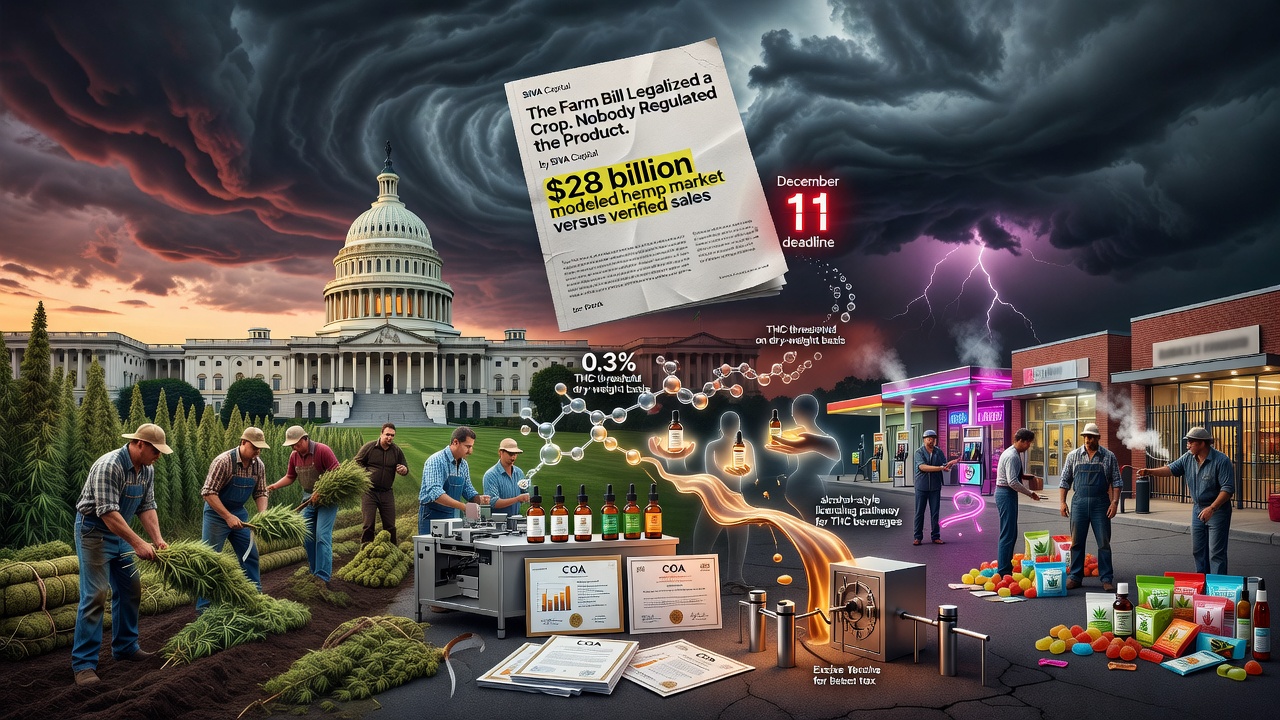
A December 11 deadline in Washington could rewrite the rules for hemp-derived products nationwide, and a new report argues that lawmakers are missing something basic: the people fighting over this market don't actually want the same thing. The 73-page analysis, The Farm Bill Legalized a Crop. Nobody Regulated the Product., comes from SIVA Capital and lands at a moment when a loophole closure, a blanket ban, or another round of delay are all still on the table.
The core argument is straightforward, even if the policy fight isn't: farmers, CBD manufacturers, patients, state-licensed cannabis operators, state regulators, and intoxicating hemp sellers are not one constituency. They have different exposure, different capital at risk, and different outcomes depending on what Congress does next. Treating them as a single "hemp industry" in testimony and lobbying materials, the report suggests, obscures who actually benefits from keeping the current loophole open.
Why the 2018 Farm Bill Created This Mess
Here's the backstory that gets glossed over in a lot of the current debate. The 2018 Farm Bill legalized hemp as an agricultural commodity, defined by a 0.3% THC threshold measured on a dry-weight basis. That threshold made sense for fiber and grain crops. It made considerably less sense once chemists figured out how to convert hemp-derived CBD into delta-8, delta-9, and other intoxicating cannabinoids sold in gas stations, vape shops, and online, often with no age-gating, no seed-to-sale tracking, and no COA requirements resembling what state-licensed cannabis operators live under every day.
That's the "loophole" everyone keeps referencing. It let a parallel intoxicating product market grow up outside the compliance infrastructure - METRC reporting, state excise tax, licensed retail footprints - that adult-use and medical cannabis operators had to build at real cost. Dispensary owners who've spent years on packaging compliance, lab testing protocols, and 280E tax exposure have watched competitors sell similar-strength products with none of that overhead.
Why Lumping These Groups Together Backfires
The report's sharpest point is about the economic case being made to protect the status quo. A widely cited $28 billion hemp-market figure, often used to argue against any tightening of the rules, is built on modeled demand rather than verified sales data. That distinction matters. Modeled projections are useful for planning; they're a shaky foundation for federal policy affecting state tax revenue, licensing structures, and public health exposure. The report asks whether employment and business-closure estimates circulating in Washington actually reflect which businesses - hemp fiber growers, CBD wellness brands, or intoxicating beverage makers - would be affected by which proposal.
In practice, though, the policy choices aren't interchangeable. Closing the loophole without harming legitimate CBD production is a narrower fix than building a wholly new intoxicating-THC regulatory regime from scratch. Conflating the two, the report argues, risks Congress either overcorrecting against non-intoxicating products patients and consumers rely on, or under-correcting in a way that cements a second, lighter-touch tax and compliance track running parallel to state cannabis programs.
A Narrower Fix on the Table
Rather than another extension or an outright ban, the report proposes letting the loophole closure proceed, repairing restrictions that have unintentionally swept up non-intoxicating CBD products, and building a tightly scoped, state-controlled pathway for THC beverages modeled on existing adult beverage distribution and licensing infrastructure - age verification, labeling, distribution controls, the works.
- Preserve non-intoxicating CBD supply chains without new restrictions that weren't the original target.
- Close the intoxicating hemp loophole rather than extending it again.
- Route THC beverages through state alcohol-style licensing rather than an unregulated federal gap.
- Avoid building a second tax and compliance structure alongside state-licensed cannabis.
For dispensary operators, multi-state brands, and state regulators watching this fight from the sidelines, the stakes go beyond December. A federal framework that formalizes a lighter-touch hemp THC market would complicate wholesale pricing, undercut state excise tax collections, and muddy the eventual path toward broader federal cannabis reform. Whatever Congress decides, it's shaping the regulatory floor the entire industry builds on for years.